
Why LLMs Alone Are Not Enough — and How RAG Fixes It
The problem nobody talks about with LLMs
When I first started working with LLMs, I had the same assumption as everyone else:
“If the model is big enough, it knows everything.”
That illusion breaks quickly in production.
Because the moment you ask something like:
- “What’s our internal policy?”
- “What happened in this dataset yesterday?”
- “What does our system currently store?”
The model confidently replies…
but often incorrectly.
That’s not a model problem. It’s a context problem.
LLMs don’t know things. They predict text.
This is the key mental shift.
An LLM is not a database.
It does not “remember” your company, your data, or your system state.
It only:
predicts the next most likely token based on training data
So it struggles with:
- fresh information
- private data
- domain-specific knowledge
- anything outside training distribution
So how do we make LLMs actually useful?
This is where things get interesting.
Instead of forcing the model to “know everything”, we give it something better:
the right context at the right time
And that idea leads to a simple but powerful architecture:
Retrieval-Augmented Generation (RAG)
The idea behind RAG (in simple terms)
Instead of asking the model to answer directly, we:
- Search relevant information
- Give it to the model
- Let it reason over it
So the model is no longer guessing.
It is grounded in real data.
RAG conceptual architecture
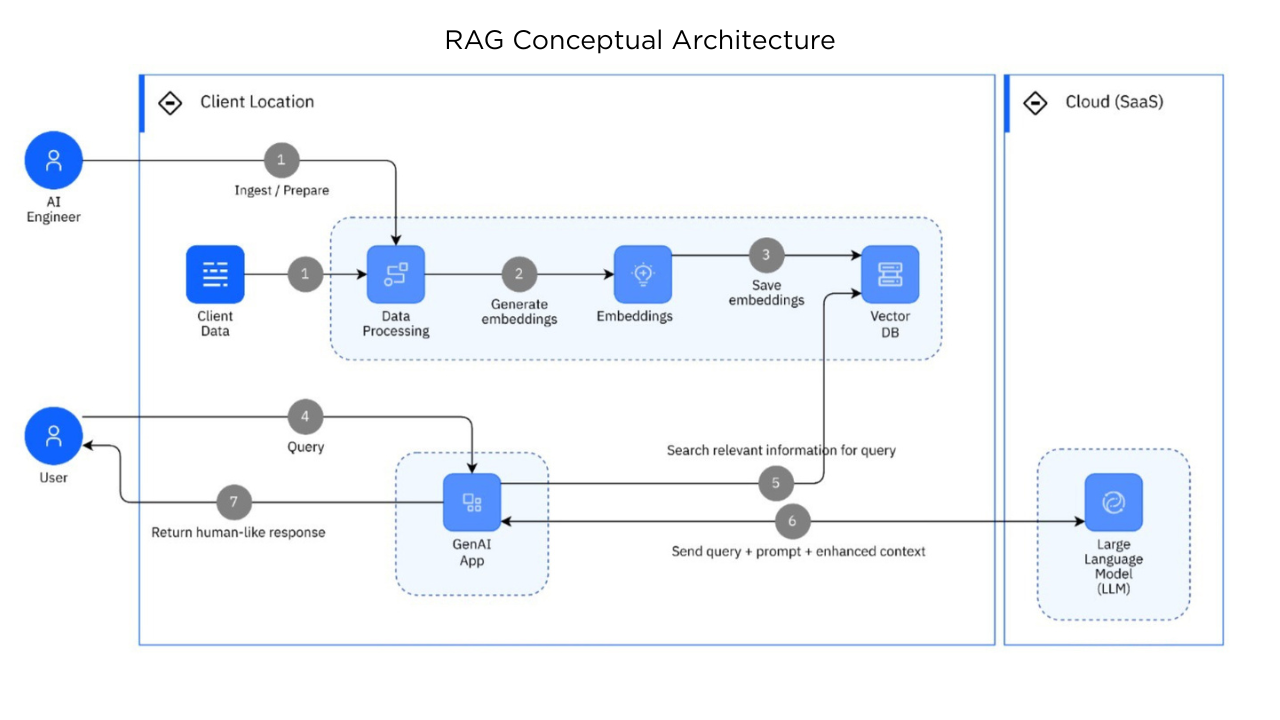
This diagram represents the full flow:
- user query
- retrieval system
- context injection
- LLM generation
Now let’s break it down step by step.
What actually happens under the hood
A typical RAG pipeline looks like this:
1. User asks a question
Example:
“What does our system do for order syncing?”
2. We retrieve relevant context
We search a knowledge source (docs, DB, files).
We usually use:
- embeddings
- vector similarity search
- top-k retrieval
3. We inject context into the prompt
Now the LLM receives:
Question + relevant documents
4. The model generates an answer
But now it is:
- grounded
- specific
- based on real data
Why this is powerful
RAG solves three major problems in LLM systems:
1. Hallucinations drop significantly
Because the model is not guessing blindly anymore.
2. No retraining needed
You can update knowledge instantly by updating documents.
3. Works with private data
Your internal system becomes queryable safely.
Real-world systems that use this pattern
This is not theory — it’s everywhere in production:
- AI customer support tools
- internal company assistants
- legal search systems
- engineering documentation bots
- data query assistants
The key insight
The real shift is this:
We stopped trying to make LLMs “know everything”
and started building systems that “feed them what matters”
Final thought
RAG is not just an AI technique.
It’s a system design pattern.
And once you understand it, you stop thinking:
“How smart is the model?”
and start thinking:
“How good is my retrieval layer?”
That’s where real AI applications are built today.