
How Load Balancers Keep Systems Reliable at Scale
Ever wondered how platforms stay online even when servers fail?
Think about services like Netflix or any large-scale application.
Even when individual servers crash, users rarely notice.
So how do these systems stay reliable under pressure?
The answer is a core system design component:
The Load Balancer
What is a Load Balancer?
A Load Balancer is a traffic controller that sits in front of your servers.
Every incoming request goes through it first, and it decides:
Which server should handle this request?
Instead of users talking directly to one server, they talk to the load balancer — which distributes traffic intelligently.
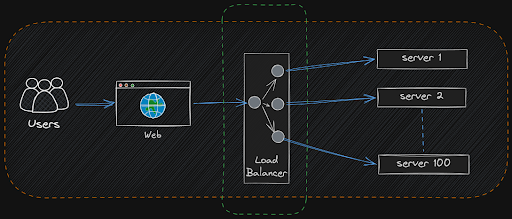
Why it matters for fault tolerance
Imagine you have 100 servers handling user traffic.
If one server suddenly goes down:
Without a Load Balancer
- Users connected to that server get errors
- Requests fail
- Parts of your system go offline
With a Load Balancer
- Traffic is automatically redirected
- Other servers take over instantly
- Users don’t notice anything
This is the foundation of fault-tolerant systems.
How does it detect failures?
Load balancers use something called Health Checks.
They continuously monitor servers by asking:
“Are you alive?”
If a server stops responding:
- it is marked as unhealthy
- removed from routing
- traffic is redistributed automatically
All of this happens in milliseconds.
Key benefits of Load Balancers
1. Scalability
You can add more servers as traffic grows without changing how users access your system.
2. Performance
Traffic is distributed evenly, preventing any single server from being overloaded.
3. Zero-downtime deployments
You can update servers gradually while others keep serving traffic.
4. Security
They hide internal server architecture from the outside world, acting as a protective layer.
The key insight
A load balancer is not just a routing tool.
It is a core building block that enables:
reliability, scalability, and resilience in modern distributed systems
Final thought
Modern systems don’t stay online because individual machines are perfect.
They stay online because the system is designed to handle failure gracefully.
And the load balancer is one of the first steps in making that possible.